Our Story
Established in 1995, Country Peddler Antiques & General Store was owned and operated by Jeaneen Cobourn and her longtime friend Debbie Denton. In March of 2025, after 30 years, the store was sold to their friend Joseph. These are people just like you who love finding fun vintage and antique items!
At the Country Peddler, you’ll get a shopping experience from days gone by. Enjoy a cold bottle of soda pop from the old Coke machine and grab a piece of your favorite old-timey candy….. NOW you’re back in those simpler times!!
Our three buildings

The General Store
Full of antiques, nostalgic candies, classic toys, unique lamps, gifts, cards, cast iron, soaps, and the “Hard-to-Find”

Old Campobello Corn Mill
Poke around our farmhouse antiques & treasures. Play checkers by the pot-bellied stove and check out the old farm tools

The Diggin’ Barn
The place for pickers, rummagers, folks who up-cycle/recycle and re-purpose fun country stuff AND for people who like yesterday’s tools
The History of Our Property
Jeaneen’s interview with Marlene, daughter of Boyd Campbell, at her home on 6/26/97 and 7/3/97.
Dad (Boyd Campbell) was called the “Will Rogers” of Campobello. He could tell a good story and could see the humor in so many things. He grew up in Gowensville hunting and hiking across Glassy and had lots of stories about all the rattlesnakes there.
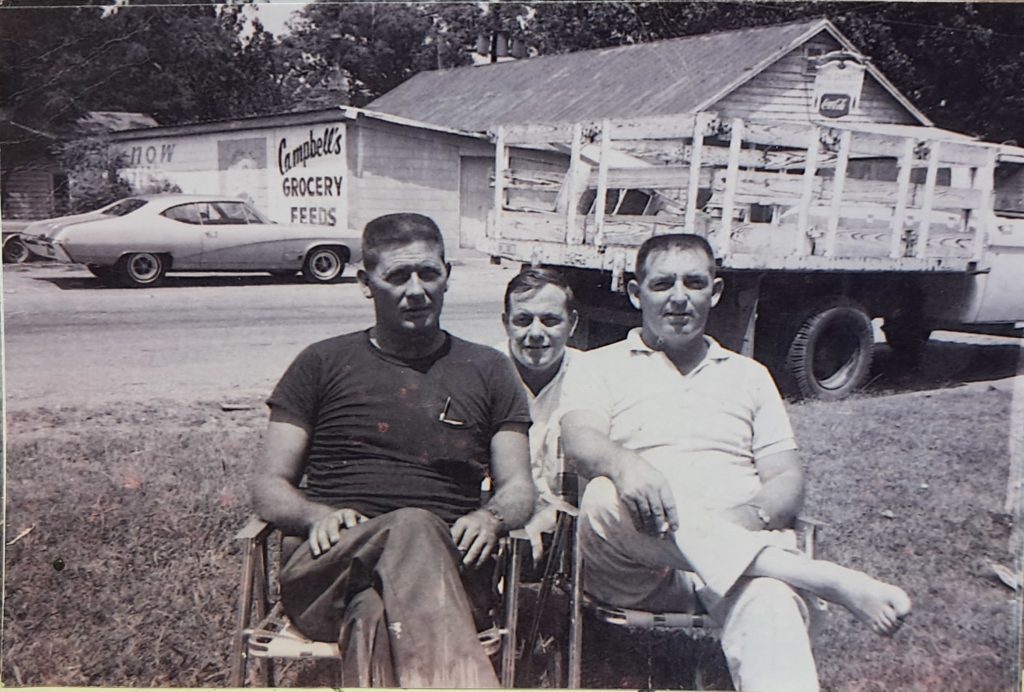
Boyd and his brother Smiley had been building houses, then decided to have a general store. They built the store on Depot Street in 1919 with curved blocks they had made themselves. Boyd’s family lived in a house made of those same blocks until Marlene was 12. The house still stands (at the time of interview) south of the used car lot at the corner of 176 and 11.
They built the new store first, then the shed, then the corn mill which was used for feed and as a corn mill. Before the corn mill was built, the brothers grew sweet potato slips and other plants to sell on that plot in a fenced garden.
Black ladies used to come dig a cupful of dirt out of the bank between the used car lot and Campbell’s when they were pregnant or after their period. Marlene didn’t know if they did something to it or ate it like that. She heard it’s high in magnesium. (Geophagy spread to the US from Africa: see https://www.thoughtco.com/geophagy-eating-dirt-1433451)
In the 30’s they built the shed. The back area was for storage of corn and feed. In about 1942, they built the current store building as a warehouse for feed in front and grocery stock in back. It was built by James Farmer. (The shed had many burned timbers and was too low for the public, so we tore it down and rebuilt a store addition and porch on the same spot in 1994.)
An electrical fire destroyed the original store in 1960; he had no insurance. (From several customers, I have been told that Campbell’s fire spurred Campobello on to get its own fire department.) By the time of the fire, Boyd had developed diabetes and was not in good health. They moved the store into the original warehouse. People came from everywhere to help. Boyd’s wife shouldered most of the responsibility for the store.
Boyd and Smiley’s dad had been a traveling butcher in the 1800s. He delivered meat in a one horse buggy to many of the homesteads in the area. Because of this, the brothers had a working knowledge of how to butcher and care for meat. Meat became their specialty. They sold primarily to farmers. Besides being a traveling butcher, the boys’ dad also taught shape note music and conducted singing schools all over.
Boyd married in the 30s. He and Smiley decided the store would not provide enough income for two families, so Smiley moved to Simpsonville, had a grocery store there and lived in an apartment over the store. It thrived but the business was very tiring. They later moved to Greenville and worked in real estate.
Claude Osteen worked at Campbell’s store for many years. He had a great personality. He was a mountain boy and told wild mountain tales. He and Boyd played many a practical joke. Salesmen would make their store the last stop of the day so they could have fun swapping stories. They got to be like family.
People used to come in wagons til the late 40s and early 50s. Some pulled little wagons by hand. Those who didn’t have a horse, walked. Boyd would always take them home. He also delivered groceries at times even though he had no phone.
Boyd was mayor of Campobello, deacon of the Baptist church, and a Sunday school teacher; people often came to him for help. He kept his credit records in a loose-leaf notebook. He carried some people and just canceled the debts of others. Social workers came from Spartanburg to ask his opinion on various people.
Prisoners on chain gangs were brought to buy cheese and bologna. Boyd was always kind to them and treated them with respect. They would sit under the chinaberry trees to eat and rest. Marlene and her brother Larry got to know some of the prisoners and were not afraid.
Boyd first kept the money in his pocket, later keeping it in a wood dovetailed chewing tobacco box that had compartments in it. He kept his bills to be paid in a King Edward cigar box on the shelf. He got a cash register in the late 50s or early 60s.
He sold everything from baby powder to horse feed. Hardware was kept in the shed with plows hanging on the walls. There were shelves from floor to ceiling, big glass cases, candy scales, box coolers for ice cream, soda, milk and juice, and a big round butcher block in the back of the store. It had been cut from a huge tree and had no legs. It was there from the 20s. There was a beautiful, very large wooden walk-in freezer for hanging meat. They took it down in the 30s or 40s, but the new meat case never looked as great.
Flour was sold in 25, 50, and 100 pound bags. They had a big scale. Dried beans, rice, and grits were also sold from bags. They carried fabric, underclothes (mostly men’s), work shirts, overalls, jeans, some farm hats, lots of socks (no shoes), but not many women’s clothes.
There was a pot bellied stove at the back 1/3 of the store. Near the meat block, they kept a hoop of cheese and coffee grinder. Kerosene was sold from pump containers inside the store.
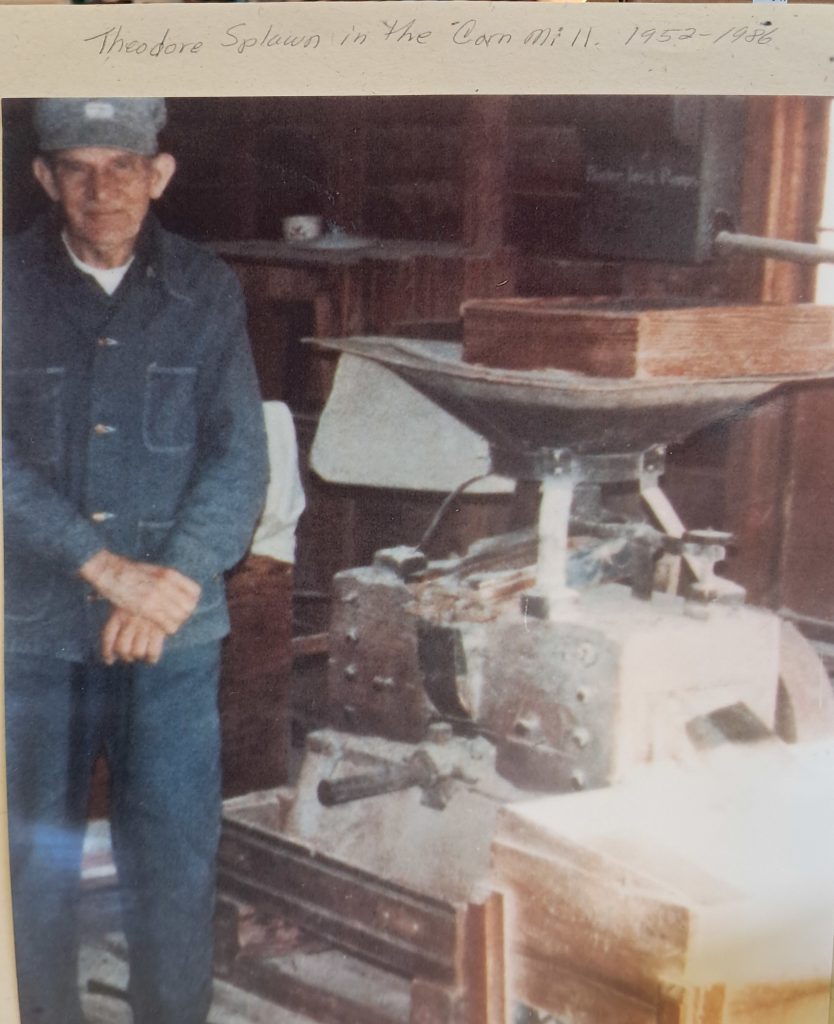
The first corn mill was located in the shed. It was all hand ground. People would use some of the corn cobs for mulch, but there was always a pile for the kids to build houses out of – like Lincoln Logs. Boyd could make wonderful animals out of them for the children too. Later there was a hammermill run by a gasoline engine – then came electric.
Boyd even had his own “store brand” of flower, etc. He went to Greenville to procure clothing, hardware, and some groceries. His children loved to go with him to see the fire engines and trolleys and go to a wonderful bakery where they mixed all the pieces from broken cookies and you could buy some very inexpensively.
Boyd Campbell’s store carried nails and bolts, Octagon Soaps, Vim Herb, patented medicines, jawbreakers, candy, chewing gum, snuff, twists of tobacco, Ponds and Jergens cosmetics, sewing supplies, and embroideries. He traded a farmer’s country brown eggs for groceries. He had potatoes and onions for farmers but left the delicate “fancy groceries” like lettuce up to Bruce’s store around the corner.
He took stamps during the war. At the front of the store was a big wood Coca-Cola wall clock. The barn building was used by Ed Perry’s auto parts at one time (around ‘68 or ‘69)– as a rug mill another. Cecil Ayers was the miller in the shed and in the new corn mill building. Theodore Splawn was the miller in the corn mill building the longest time. He did a good job.
Mr. Robert Bishop (husband of Della Bishop) who had the blacksmith shop (and then cars) near where the post office is now didn’t believe in doctors. When a car would fall on him or he’d get cut open in some way, he’d stitch it up himself. If it was bad, he’d go get Boyd Campbell to stitch it up for him using a rusty old needle he used for harnesses, etc. He amazingly never got sick or infected.
Boyd Campbell died in 1974. His wife passed away last year (1996). Campbell’s store closed about 1969.
Jeaneen Cobourn and Marlene Campbell Douglas, 1997


Welcome to Country Peddler Antiques & General Store!
Step back in time and explore our collection of vintage and antique items.
Discover the nostalgia and charm of days gone by. Visit us today!